

-
1 a good 'solid' reliable person
Jargon: diamond geezerУниверсальный русско-английский словарь > a good 'solid' reliable person
-
2 солидный человек
Русско-английский большой базовый словарь > солидный человек
-
3 основательный человек
Law: solid personУниверсальный русско-английский словарь > основательный человек
-
4 солидный человек
-
5 благоразумный человек
1) General subject: well-advised man2) Business: prudent person, reasonable man3) Makarov: a man of solid sense, man of solid sense, sensible personУниверсальный русско-английский словарь > благоразумный человек
-
6 С-567
КАК ЗА КАМЕННОЙ СТЕНОЙ жить, чувствовать себя и т. п. coll (как + PrepP Invar adv or subj-compl with copula (subj: human fixed WO(to live, feel that one is) under s.o. 's reliable protection or patronage: (one is (feels)) safe with s.o.(one lives) as safely as behind a stone wall (in s.o., one has) a good solid wall to protect one with s.o., one is (feels) protected (shielded etc) from everything.(Нина:) Сегодня я вас познакомлю. Он (мой жених) хороший парень. (Бусыгин:) Я представляю. Наверно, он большой и добрый... Волевой, целеустремленный. В общем, за ним ты - как за каменной стеной (Вампилов 4). (N.:) I'll introduce you (to my fiance) tonight. He's a nice fellow.(В.:) I can imagine. He's probably big and kind-hearted....Strong-willed, highly motivated. In general, you'll be safe with him (4b).«Нина -женщина от земли. Её не столько интересует мужчина, сколько хозяин в доме, за спиной которого можно жить, как за каменной стеной» (Черненок 2). "Nina is an earthy woman. She's not as interested in a man so much as in a master of the house behind whose back she can live as safely as behind a stone wall" (2a).Лукашин:) Уже тридцать два... (Задумчиво.) А семьи всё нет. Ну, не складывалось... Не повезло. И вдруг появляется Ипполит, положительный, серьёзный... хороший... С ним спокойно, надёжно... За ним как за каменной стеной. Он ведь, наверно, выгодный жених (Брагинский и Рязанов 1). (L.:) Thirty-two... (Thoughtfully.) And you still haven't a family. Well, things didn't work out....Just bad luck. And suddenly Ippo lit appears, a positive, serious person.... A good person....Life with him would be safe, peaceful, steady.... A good solid wall to protect you. Yes, he looks like a fine prospective husband (1a). -
7 как за каменной стеной
• КАК ЗА КАМЕННОЙ СТЕНОЙ жить, чувствовать себя и т.п. coll[ как + PrepP; Invar; adv or subj-compl with copula (subj: human); fixed WO]=====⇒ (to live, feel that one is) under s.o.'s reliable protection or patronage:- (one is < feels>) safe with s.o.;- (in s.o., one has) a good solid wall to protect one;- with s.o., one is (feels) protected (shielded etc) from everything.♦ [Нина:] Сегодня я вас познакомлю. Он [мой жених] хороший парень. [Бусыгин:] Я представляю. Наверно, он большой и добрый... Волевой, целеустремлённый. В обшем, за ним ты - как за каменной стеной (Вампилов 4). [N.:] I'll introduce you [to my Аапсё] tonight. He's a nice fellow. [В.:] I can imagine. He's probably big and kind-hearted....Strong-willed, highly motivated. In general, you'll be safe with him (4b).♦ "Нина - женщина от земли. Её не столько интересует мужчина, сколько хозяин в доме, за спиной которого можно жить, как за каменной стеной" (Чернёнок 2). "Nina is an earthy woman. She's not as interested in a man so much as in a master of the house behind whose back she can live as safely as behind a stone wall" (2a).♦ [Лукашин:] Уже тридцать два... (Задумчиво.) А семьи всё нет. Ну, не складывалось... Не повезло. И вдруг появляется Ипполит, положительный, серьёзный... хороший... С ним спокойно, надёжно... За ним как за каменной стеной. Он ведь, наверно, выгодный жених (Брагинский и Рязанов 1). [L.:] Thirty-two... (Thoughtfully.) And you still haven't a family. Well, things didn't work out....Just bad luck. And suddenly Ippolit appears, a positive, serious person.... A good person....Life with him would be safe, peaceful, steady.... A good solid wall to protect you. Yes, he looks like a fine prospective husband (1a).Большой русско-английский фразеологический словарь > как за каменной стеной
-
8 С-84
БРАТЬ/ВЗЯТЬ СВОЁ VP1. (subj: humanusu. pfv) to achieve one's desired, established aim (when in conflict with another person or when struggling against adverse circumstances)X возьмёт своё = X will succeed (prevail, win out)X will get (have) his way (in limited contexts) X's turn (day, moment) will come X will get back at person Y X will take his revenge.«Дождались станишники (phonetic spelling = станичники) своего часа. И уж они, будьте покойны, они своё возьмут» (Максимов 3). This is just what the Cossacks have been waiting for. They'll take their revenge, don't you worry" (3a).2. ( subj: a noun denoting a season, natural phenomenon etc) to manifest itself fullyX возьмёт своё = X will come into its own....Весна брала своё. Все кругом золотисто зеленело... (Тургенев 2)....Spring was coming into its own. All around him was the gold and verdure of spring... (2a).3. ( subj: abstr) to render its typical effect, dominate, usu. in an evident mannerX брал свое - X was making itself feltX was having its way X was claiming its own X was prevailing ( usu. of old age, illness etc) X was taking its toll X was telling (on person Y) X was catching up (with person Y) (of age only) person Y was feeling his age (of disease only) X was overpowering person Y.Так жила тетя Маша со своими богатырскими дочерями -бедно, вольно, неряшливо. Дети и сама она питались чем попало, но могучая природа брала своё, и все они выглядели румяными, сильными, довольными (Искандер 3). Thus Aunt Masha lived with her herculean daughters-poor, free, and slovenly. The children, and she herself, lived from hand to mouth, but mighty nature had its way and all of them looked rosy, strong, and content (3a).«...Слышу, патер в дырочку (исповедальни) ей (девушке) назначает вечером свидание, а ведь старик - кремень, и вот пал в одно мгновение! Природа-то, правда-то природы взяла своё!» (Достоевский 2). "...I heard the priest arranging a rendezvous with her (the girl) for that evening through the hole (of the confessional booth)the old man was solid as a rock, but he fell in an instant! It was nature, the truth of nature, claiming its own!" (2a)....Молодость брала своё: горе Наташи начало покрываться слоем впечатлений прожитой жизни, оно перестало такою мучительною болью лежать ей на сердце, начинало становиться прошедшим, и Наташа стала физически оправляться (Толстой 6)....Youth prevailed: Natasha's grief began to be submerged under the impressions of daily life and ceased to weigh so heavily on her heart, it gradually faded into the past, and she began to recover physically (6a).Он был уже так слаб от двенадцати (уколов), уже (врачи) качали головами над его анализами крови, - а надо было выдержать ещё столько же? Не мытьём, так катаньем болезнь брала своё (Солженицын 10). Не was so weak from the twelve (injections) he had had-already they (the doctors) were shaking their heads over his blood count-might he really have to endure the same number again? By hook or by crook the disease was overpowering him (10a). -
9 брать свое
• БРАТЬ/ВЗЯТЬ СВОЕ[VP]=====1. [subj: human; usu. pfv]⇒ to achieve one's desired, established aim (when in conflict with another person or when struggling against adverse circumstances):- X возьмёт своё≈ X will succeed (prevail, win out);- [in limited contexts] X's turn (day, moment) will come;- X will take his revenge.♦ "Дождались станишники [phonetic spelling = станичники] своего часа. И уж они, будьте покойны, они своё возьмут" (Максимов 3). "This is just what the Cossacks have been waiting for. They'll take their revenge, don't you worry" (3a).2. [subj: a noun denoting a season, natural phenomenon etc]⇒ to manifest itself fully:- X возьмёт своё≈ X will come into its own.♦...Весна брала своё. Все кругом золотисто зеленело... (Тургенев 2)....Spring was coming into its own. All around him was the gold and verdure of spring... (2a).3. [subj: abstr]⇒ to render its typical effect, dominate, usu. in an evident manner:- [usu. of old age, illness etc] X was taking its toll;- [of age only] person Y was feeling his age;- [of disease only] X was overpowering person Y.♦ Так жила тетя Маша со своими богатырскими дочерями - бедно, вольно, неряшливо. Дети и сама она питались чем попало, но могучая природа брала своё, и все они выглядели румяными, сильными, довольными (Искандер 3). Thus Aunt Masha lived with her herculean daughters-poor, free, and slovenly. The children, and she herself, lived from hand to mouth, but mighty nature had its way and all of them looked rosy, strong, and content (3a).♦ "...Слышу, патер в дырочку [исповедальни] ей [девушке] назначает вечером свидание, а ведь старик - кремень, и вот пал в одно мгновение! Природа-то, правда-то природы взяла своё!" (Достоевский 2). "...I heard the priest arranging a rendezvous with her [the girl] for that evening through the hole [of the confessional booth]; the old man was solid as a rock, but he fell in an instant! It was nature, the truth of nature, claiming its own!" (2a).♦...Молодость брала своё: горе Наташи начало покрываться слоем впечатлений прожитой жизни, оно перестало такою мучительною болью лежать ей на сердце, начинало становиться прошедшим, и Наташа стала физически оправляться (Толстой 6)....Youth prevailed: Natasha's grief began to be submerged under the impressions of daily life and ceased to weigh so heavily on her heart; it gradually faded into the past, and she began to recover physically (6a).♦ Он был уже так слаб от двенадцати [уколов], уже [врачи] качали головами над его анализами крови, - а надо было выдержать ещё столько же? Не мытьём, так катаньем болезнь брала своё (Солженицын 10). He was so weak from the twelve [injections] he had had-already they [the doctors] were shaking their heads over his blood count-might he really have to endure the same number again? By hook or by crook the disease was overpowering him (10a).Большой русско-английский фразеологический словарь > брать свое
-
10 взять свое
• БРАТЬ/ВЗЯТЬ СВОЕ[VP]=====1. [subj: human; usu. pfv]⇒ to achieve one's desired, established aim (when in conflict with another person or when struggling against adverse circumstances):- X возьмёт своё≈ X will succeed (prevail, win out);- [in limited contexts] X's turn (day, moment) will come;- X will take his revenge.♦ "Дождались станишники [phonetic spelling = станичники] своего часа. И уж они, будьте покойны, они своё возьмут" (Максимов 3). "This is just what the Cossacks have been waiting for. They'll take their revenge, don't you worry" (3a).2. [subj: a noun denoting a season, natural phenomenon etc]⇒ to manifest itself fully:- X возьмёт своё≈ X will come into its own.♦...Весна брала своё. Все кругом золотисто зеленело... (Тургенев 2)....Spring was coming into its own. All around him was the gold and verdure of spring... (2a).3. [subj: abstr]⇒ to render its typical effect, dominate, usu. in an evident manner:- [usu. of old age, illness etc] X was taking its toll;- [of age only] person Y was feeling his age;- [of disease only] X was overpowering person Y.♦ Так жила тетя Маша со своими богатырскими дочерями - бедно, вольно, неряшливо. Дети и сама она питались чем попало, но могучая природа брала своё, и все они выглядели румяными, сильными, довольными (Искандер 3). Thus Aunt Masha lived with her herculean daughters-poor, free, and slovenly. The children, and she herself, lived from hand to mouth, but mighty nature had its way and all of them looked rosy, strong, and content (3a).♦ "...Слышу, патер в дырочку [исповедальни] ей [девушке] назначает вечером свидание, а ведь старик - кремень, и вот пал в одно мгновение! Природа-то, правда-то природы взяла своё!" (Достоевский 2). "...I heard the priest arranging a rendezvous with her [the girl] for that evening through the hole [of the confessional booth]; the old man was solid as a rock, but he fell in an instant! It was nature, the truth of nature, claiming its own!" (2a).♦...Молодость брала своё: горе Наташи начало покрываться слоем впечатлений прожитой жизни, оно перестало такою мучительною болью лежать ей на сердце, начинало становиться прошедшим, и Наташа стала физически оправляться (Толстой 6)....Youth prevailed: Natasha's grief began to be submerged under the impressions of daily life and ceased to weigh so heavily on her heart; it gradually faded into the past, and she began to recover physically (6a).♦ Он был уже так слаб от двенадцати [уколов], уже [врачи] качали головами над его анализами крови, - а надо было выдержать ещё столько же? Не мытьём, так катаньем болезнь брала своё (Солженицын 10). He was so weak from the twelve [injections] he had had-already they [the doctors] were shaking their heads over his blood count-might he really have to endure the same number again? By hook or by crook the disease was overpowering him (10a).Большой русско-английский фразеологический словарь > взять свое
-
11 степень защиты (обеспечиваемая оболочкой)
- protection rating
- protection index
- protection
- mechanical rating
- level of protection
- IPSec
- IP security
- IP Sealing Specification
- IP rating
- IP degree of protection,
- IP
- ingress protection rating
- enclosure rating
- degree of protection provided by enclosure
- degree of protection of enclosure
- degree of protection of an enclosure
- degree of protection IP
- amount of protection
степень защиты
Способ защиты, обеспечиваемый оболочкой от доступа к опасным частям, попадания внешних твердых предметов и (или) воды и проверяемый стандартными методами испытаний.
[ ГОСТ 14254-96( МЭК 529-89)]
степень защиты, обеспечиваемая оболочкой (IP)
Числовые обозначения после кода IP, которые в соответствии с МЭК 60529 [12] характеризуют оболочку электрооборудования, обеспечивающую:
- защиту персонала от прикасания или доступа к находящимся под напряжением или движущимся частям (за исключением гладких вращающихся валов и т.п.), расположенным внутри оболочки;
- защиту электрооборудования от проникания в него твердых посторонних тел и,
- если указано в обозначении, защиту электрооборудования от вредного проникания воды.
[ ГОСТ Р МЭК 60050-426-2006]EN
degree of protection of enclosure
IP (abbreviation)
numerical classification according to IEC 60529 preceded by the symbol IP applied to the enclosure of electrical apparatus to provide:
– protection of persons against contact with, or approach to, live parts and against contact with moving parts (other than smooth rotating shafts and the like) inside the enclosure,
– protection of the electrical apparatus against ingress of solid foreign objects, and
– where indicated by the classification, protection of the electrical apparatus against harmful ingress of water
[IEV number 426-04-02 ]FR
degré de protection procuré par une enveloppe
IP (abréviation)
classification numérique selon la CEI 60529, précédée du symbole IP, appliquée à une enveloppe de matériel électrique pour apporter:
– une protection des personnes contre tout contact ou proximité avec des parties actives et contre tout contact avec une pièce mobile (autre que les roulements en faible rotation) à l'intérieur d'une enveloppe
– une protection du matériel électrique contre la pénétration de corps solide étrangers, et
– selon l’indication donnée par la classification, une protection du matériel électrique contre la pénétration dangereuse de l’eau
[IEV number 426-04-02 ]Элементы кода IP и их обозначения по ГОСТ 14254-96( МЭК 529-89)
Цифры кода IP
Значение для защиты оборудования от проникновения внешних твердых предметов
Значение для защиты людей от доступа к опасным частям
Первая характеристическая цифра
0
Нет защиты
Нет защиты
1
диаметром ≥ 50 мм
тыльной стороной руки
2
диаметром ≥ 12,5 мм
пальцем
3
диаметром ≥ 2,5 мм
инструментом
4
диаметром ≥ 1,0 мм
проволокой
5
пылезащищенное
проволокой
6
пыленепроницаемое
проволокой
От вредного воздействия в результате проникновения воды
Вторая характеристическая цифра
0
Нет защиты
-
1
Вертикальное каплепадение
2
Каплепадение (номинальный угол 15°)
3
Дождевание
4
Сплошное обрызгивание
5
Действие струи
6
Сильное действие струи
7
Временное непродолжительное погружение
8
Длительное погружение
Дополнительная буква (при необходимости)
-
От доступа к опасным частям
A
тыльной стороной руки
B
пальцем
C
инструментом
проволокой
Вспомогательная буква (при необходимости)
Вспомогательная информация относящаяся к:
-
H
высоковольтным аппаратам
M
состоянию движения во время испытаний защиты от воды
S
состоянию неподвижности во время испытаний защиты от воды
W
Требования в части стойкости оболочек и электрооборудования в целом к климатическим, механическим внешним воздействующим факторам (ВВФ) и специальным средам (кроме проникновения внешних твердых предметов и воды) установлены вне рамок настоящего стандарта.
Параллельные тексты EN-RU
The code IP indicates the degrees of protection provided by an enclosure against access to hazardous parts, ingress of solid foreign objects and ingress of water.
The degree of protection of an enclosure is identified, in compliance with the specifications of the Standard IEC 60529, by the code letters IP (International Protection) followed by two numerals and two additional letters.
The first characteristic numeral indicates the degree of protection against ingress of solid foreign objects and against contact of persons with hazardous live parts inside the enclosure.
The second characteristic numeral indicates the degree of protection against ingress of water with harmful effects.
[ABB]Код IP обозначает степень защиты, обеспечиваемую оболочкой от попадания внутрь твердых посторонних предметов и воды.
Степень защиты оболочки обозначается в соответствии со стандартом МЭК 60529 буквенным обозначением IP (International Protection, т. е. Международная защита) после которого следуют две цифры, к которым в некоторых случаях добавляются еще две буквы.
Первая характеристическая цифра обозначает степень защиты от проникновения твердых посторонних предметов и от контакта людей с находящимися внутри оболочки опасными токоведущими частями.
Вторая характеристическая цифра обозначает степень защиты оболочки с точки зрения вредного воздействия, оказываемого проникновением воды.
[Перевод Интент]The protection of enclosures against ingress of dirt or against the ingress of water is defined in IEC529 (BSEN60529:1991). Conversely, an enclosure which protects equipment against ingress of particles will also protect a person from potential hazards within that enclosure, and this degree of protection is also defined as a standard.
The degrees of protection are most commonly expressed as ‘IP’ followed by two numbers, e.g. IP65, where the numbers define the degree of protection. The first digit shows the extent to which the equipment is protected against particles, or to which persons are protected from enclosed hazards. The second digit indicates the extent of protection against water.
The wording in the table is not exactly as used in the standards document, but the dimensions are accurateIP Degree of Protection according to EN/IEC 60529
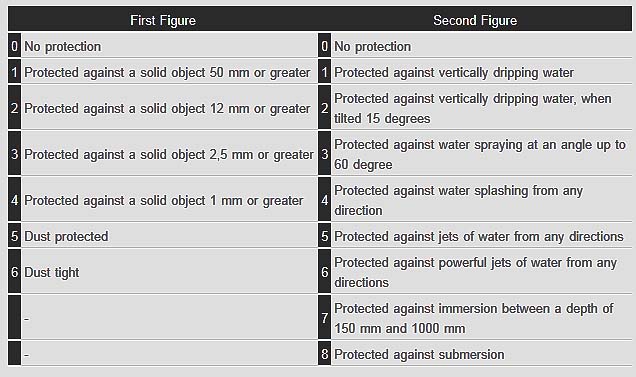
Correlations between IP (IEC) and NEMA 250 standards
IP10 -> NEMA 1
IP11 -> NEMA 2
IP54 -> NEMA 3 R
IP52 -> NEMA 5-12-12 K
IP54 -> NEMA 3-3 S
IP56 -> NEMA 4-4 X
IP67 -> NEMA 6-6 P[ http://electrical-engineering-portal.com/ip-protection-degree-iec-60529-explained]
Тематики
- безопасность машин и труда в целом
- электробезопасность
- электротехника, основные понятия
Действия
- степень защиты
- степень защиты, обеспечиваемая оболочкой
- степень защиты, обеспечиваемая оболочкой (код IP)
EN
- amount of protection
- degree of protection IP
- degree of protection of an enclosure
- degree of protection of enclosure
- degree of protection provided by enclosure
- enclosure rating
- ingress protection rating
- IP
- IP degree of protection,
- IP rating
- IP Sealing Specification
- IP security
- IPSec
- level of protection
- mechanical rating
- protection
- protection index
- protection rating
DE
- IP-Schutzgrad, m
- Schutzart des Gehäuses, f
FR
Русско-английский словарь нормативно-технической терминологии > степень защиты (обеспечиваемая оболочкой)
-
12 серьезный
1. thorough, solidЭта организация нуждается в серьезной реформе — this organization needs a thorough reform.Это серьезная работа — This is a solid piece of work.2. serious, carefulМы ожидаем, что американская сторона со всей серьезностью отнесется к изложенным соображениям. - We expect that the American side will give serious/careful consideration to the views expressed here.@ несерьезныйthoughtless, flippantДанное заявление (г-на Чейни) является некомпетентным и несерьезным… - That particular statement is out of Mr. Cheney’s area of experience/jurisdiction (не incompetent!) and thoughtless/flippant (не not serious!).@ серьезный человекserious person – обделенный чувством юмора!He means business/knows what he is talking about/he is an experienced professional @ серьезный ученыйreputable, eminent, knowledgeable, professional scientist@ это несерьезноThat would be irresponsible/nonprofessional/wrong.You don't/can't mean that. You must be kidding. @Словарь переводчика-синхрониста (русско-английский) > серьезный
-
13 цельный
прл1) из одного куска, сплошной of one piece, solidце́льный грани́т — solid granite/rock
2)це́льный хара́ктер — a person of integrity
-
14 воздействие электрической дуги на человека
воздействие электрической дуги на человека
-
[Интент]Параллельные тексты EN-RU
Effects of the electrical arc on human beings
From the above, it is evident that the electrical arc represents a hazard source for people and goods.
The hazards to which a person is exposed due to the release of energy generated by an arc event are:
• burns;
• injuries due to ejection of materials;
• damages to hearing;
• inhalation of toxic gases.
Burns
The high temperature levels of the gases produced by the electrical arc and the expulsion of incandescent metal particles may cause more or less severe burns to people.
Flames can cause all degrees of burn up to carbonization: the red-hot solid bodies, such as the metal fragments of the assembly involved, cause third degree burns, superheated steam causes burns analogous to those by hot liquids whereas radiant heat generally causes less severe burns.
Injuries due to ejection of materials
The ejection of metal particles or other loose items caused by the electrical arc can result in severe injuries to the weakest parts of the human body as, for example, the eyes.
The materials expelled owing to the explosion produced by the arc may penetrate the cornea and hurt it.
The extent of the lesions depends on the characteristics and on the kinetic energy of these objects.
Moreover, the ocular region can sustain injuries to the mucosa because of the gases released by the arc and the emission of ultraviolet and infrared rays can injure the cornea and the retina depending on the radiation wavelengths.
Hearing
As already mentioned, the electrical arc is a real explosion, whose sound may cause permanent injuries to hearing.
Inhalation of toxic gases
The fumes produced by burnt insulating materials and by molten or vaporized metals can be toxic.
The fumes are caused by incomplete burning and are formed by carbon particles and by other solid substances suspended in the air.
[ABB]Воздействие электрической дуги на человека
Из сказанного выше совершенно очевидно, что электрическая дуга является источником опасности для людей и имущества.
При высвобождении энергии электрической дуги человек может подвергнуться следующим опасностям:
• получение ожогов;
• повреждения от выброса продуктов горения дуги;
• нарушение слуха;
• вдыхание ядовитых газов.
Ожоги
Высокая температура газов, образующихся при горении электрической дуги, и выброс раскаленных частиц металла могут явиться причиной достаточно тяжелых ожогов.
Можно получить любую степень ожогов, вплоть до обугливания. Раскаленные до красна твердые частицы, такие как металлические частицы НКУ, вызывают ожоги третьей степени. Перегретый пар вызывает ожоги, аналогичные ожогам от горячих жидкостей. Лучистая энергия вызывает менее тяжелые ожоги.
Повреждения от выброса продуктов горения дуги
Выброс металлических или иных частиц, происходящий при горении электрической дуги, может привести к серьезным телесным повреждениям, особенно при попадании в глаза.
Частицы, выбрасываемые при горении дуги, могут проникнуть в роговую оболочку глаза и повредить ее.
Степень поражения зависит от характеристик и кинетической энергии выбрасываемых частиц.
Кроме того, газы, выделяющиеся в процессе горения дуги, могут повредить слизистую оболочку глаз, а ультрафиолетовое и инфракрасное излучение – роговую оболочку и сетчатку в зависимости от длины волны воздействующего излучения.
Орган слуха
Как уже упоминалось, электрическая дуга представляет собой реальный взрыв, звук которого может нанести тяжелую травму органу слуха.
Вдыхание ядовитых газов
Продукты горения изоляционных материалов и пары металлов могут быть ядовитыми.
Дым, образующийся при неполном сгорании и содержащий частицы углерода и других веществ, попадает в окружающий воздух.
[Перевод Интент]Тематики
- НКУ (шкафы, пульты,...)
EN
Русско-английский словарь нормативно-технической терминологии > воздействие электрической дуги на человека
-
15 тупица
1) General subject: Boeotian, CH, asshead, banana head, beef head, beetle, beetle head, blimp, blockhead, bone-head, bufflehead, bullhead, chili bowl, chili-bowl, clodpate, clodpole, clodpoll, clonk, clot, cloth head, clunk, crack-head, dullard, dumb egg, dummy, dump egg, dunce, flat, food for squirrels, four-letter man, gink, hammer head, jerk, josser, lard head, lob, lubber head, lubber-head, lump, lumpish boor, muddle-head, nowt, numbskull, numskull, oaf, ouph, ouphe, sap, schmuck, slob, slowcoach, stick, thick head, thick skull, thick-head, thickhead, wampus, wittol, wooden-head, woodenhead, ignoramus, dipstick, beetle-brain, doof, dufus, kaputnik, stupid thing, nitwit, butthead, lemon, leather-head2) Colloquial: Colonel Blimp, beetle-head, cabbage head, cabbage-head, cloth-head, dimwit, dodo, duffer, fiddlehead, goof, numnut, pigbrain (= pighead), pigsconce, pinhead, punk, thick, thicko, doofus, ass maggot, idiot, Pighead3) Slang: goon4) American: banana-head, cheese, foozle, lard-head, lunk, lunkhead, nerd, nurd, peahead, schmo, schmoe, schnook, wooden Indian5) Obsolete: hammer-head8) Irish: Gowl9) Psychology: dull normal10) Jargon: arse, bonehead, clunkhead, dum-dum, dumb-dumb, dumdum, meathead, mope, mush-head, nudnik, oil can, pin-head, solid ivory, yack, yak, yock, yuck, yuk, zombi, zombie, dope (I'm not such a dope. Я не такой тупица.), turkey (You are such a turkey! Ты такая тупица!), tool (stupid person), (задница) Caffler, numbhead, cheesehead, lorg, lug, strawberry, divvy, gomer, clunker12) Invective: fuckhead13) Makarov: a wooden head, wooden head14) Taboo: ass-brain, ass-head, ass-hole, barf bag, berk, bit of a knob (см. knob), bletherskate, cheesy helmet, damn fool, darnfoolski, dingleberry, dink, dumb-ass, fuck-knuckle, gack, gee-bag (см. gee), gooberhead, mong, muppet, nucker, shit-head, silly ass, wank stain15) Phraseological unit: melon head -
16 Б-119
HE ДАЙ (HE ПРИВЕДИ) БОГ (БОЖЕ, ГОС-ПОДИ) НЕ ПРИВЕДИ ГОСПОДЬ all coll these forms only fixed WO1. ( indep. clause, sent adv (parenth), or predic (with subj: usu. infin)) (used to express concern that sth. disagreeable may happen, a warning to s.o. not to do sth., or the unde-sirability, inadmissibility of sth.) it would be bad, unfortunate if... God (heaven) forbid(may) God preserve (save) s.o. (from sth.) God (heaven) help s.o. (if...) (in limited contexts) (avoid sth.) at all costs."А если бы сбились с пути, да до утра, не приведи господи, закоченели бы как ледышки» (Айтматов 1). "What if you'd been lost right through until morning, God forbid? You'd have frozen solid, like icicles" (1b)...В первую же ночь тайному суровому испытанию подвергалась ее любовь: не дай бог, не появился ли в ней какой-нибудь новый опыт (Трифонов 1). The very first night upon her return she would secretly be put to the test, and heaven forbid that her lovemaking reveal any new experience (1a).Лука Лукич:) He приведи бог служить по ученой части, всего боишься. Всякий мешается, всякому хочется показать, что он тоже умный человек (Гоголь 4). (L.L.:) God help anyone whose job has anything to do with education! You're afraid of everything, everybody interferes, everybody wants to show that he is an intelligent man too (4b).Они (Ирина Викторовна и Никандров) чувствовали необходимость сохранения некоторой дистанции между собой, чтобы, не дай бог, не случилось такой близости, когда одному известно о другом всё... (Залыгин 1). They (Irina Viktorovna and Nikandrov) felt it necessary to maintain a certain distance between each other, to avoid at all costs growing so close that each knew everything about the other... (1a).2. ( usu. predic (with subj: any common noun), indep. clause, or adv ( intensif)) (a person or thing is) extremely bad, awful etc, (some undesirable quality is) very strongly manifested, (some undesirable action is carried out) with extreme intensitygoodness (God), how AdjP one (sth.) isone got ( sth. is etc) incredibly AdjP ( s.o. (sth.)) like I hope never to see (hear etc) again God, may the Lord) save us (you etc) from such a NP (from a NP like that) God (may the Lord) spare you (me etc) a NP like that (in limited contexts) I wouldn't wish him (her, that etc) on my worst enemy (as a response to a question or a rejoinder to an exclamation) God, yes! and how! (in limited contexts) a God-awful NP. «Когда я был еще подпоручиком, раз, знаете, мы подгуляли между собою, а ночью сделалась тревога вот мы и вышли перед фрунт навеселе, да уж и досталось нам, как Алексей Петрович узнал: не дай господи, как он рассердился!» (Лермонтов 1). "When I was still a second lieutenant we all got a little high one time, and during the night there was an alarmso we came out lit up in front of the soldiers, and did we get it from Aleksey Petrovich when he found outgoodness, how furious he was!" (1a).«Измаялась я с ней (Галькой), - стала жаловаться Степа-нида. - Ой девка, не приведи господь никому такую» (Распутин 1). "She's (Galia has) wore me out," began Stepanida plaintively. "The little beast! I wouldn't wish her on my worst enemy" (1a).Поступайте в кондуктора! Вы не можете заниматься зоологией», - неслось из кабинета. «Строг?» - спрашивал котелок у Панкрата. «У, - не приведи бог», - отвечал Панк-рат... (Булгаков 10). ( context transl) "Go and get jobs as conductors! You aren't fit to study zoology," came from the office. "Strict, eh?" the derby asked Pankrat. "A holy terror," answered Pankrat (10a). -
17 не дай бог
• НЕ ДАЙ < НЕ ПРИВЕДИ> БОГ <БОЖЕ, ГОСПОДИ>; НЕ ПРИВЕДИ ГОСПОДЬall coll[these forms only; fixed WO]=====1. [indep. clause, sent adv (parenth), or predic (with subj: usu. infin)]⇒ (used to express concern that sth. disagreeable may happen, a warning to s.o. not to do sth., or the undesirability, inadmissibility of sth.) it would be bad, unfortunate if... God (heaven) forbid; (may) God preserve (save) s.o. (from sth.); God (heaven) help s.o. (if...); [in limited contexts](avoid sth.) at all costs.♦ "А если бы сбились с пути, да до утра, не приведи господи, закоченели бы как ледышки" (Айтматов 1). "What if you'd been lost right through until morning, God forbid? You'd have frozen solid, like icicles" (1b)♦...В первую же ночь тайному суровому испытанию подвергалась ее любовь: не дай бог, не появился ли в ней какой-нибудь новый опыт (Трифонов 1). The very first night upon her return she would secretly be put to the test, and heaven forbid that her lovemaking reveal any new experience (1a).♦ [Лука Лукич:] Не приведи бог служить по ученой части, всего боишься. Всякий мешается, всякому хочется показать, что он тоже умный человек (Гоголь 4). [L.L.:] God help anyone whose job has anything to do with education! You're afraid of everything, everybody interferes, everybody wants to show that he is an intelligent man too (4b).♦ Они [Ирина Викторовна и Никандров] чувствовали необходимость сохранения некоторой дистанции между собой, чтобы, не дай бог, не случилось такой близости, когда одному известно о другом всё... (Залыгин 1). They [Irina Viktorovna and Nikandrov] felt it necessary to maintain a certain distance between each other, to avoid at all costs growing so close that each knew everything about the other... (1a).2. [usu. predic (with subj: any common noun), indep. clause, or adv (intensif)]⇒ (a person or thing is) extremely bad, awful etc, (some undesirable quality is) very strongly manifested, (some undesirable action is carried out) with extreme intensity:- goodness (God), how [AdjP] one (sth.) is;- one got (sth. is etc) incredibly [AdjP];- (s.o. < sth.>) like I hope never to see (hear etc) again;- God (may the Lord) spare you (me etc) a [NP] like that;- [in limited contexts] I wouldn't wish him (her, that etc) on my worst enemy;- [as a response to a question or a rejoinder to an exclamation] God, yes!;- and how!;- [in limited contexts] a God-awful [NP].♦ "Когда я был еще подпоручиком, раз, знаете, мы подгуляли между собою, а ночью сделалась тревога; вот мы и вышли перед фрунт навеселе, да уж и досталось нам, как Алексей Петрович узнал: не дай господи, как он рассердился!" (Лермонтов 1). "When I was still a second lieutenant we all got a little high one time, and during the night there was an alarm; so we came out lit up in front of the soldiers, and did we get it from Aleksey Petrovich when he found out: goodness, how furious he was!" (1a).♦ "Измаялась я с ней [Галькой], - стала жаловаться Степанида. - Ой девка, не приведи господь никому такую" (Распутин 1). "She's [Galia has] wore me out," began Stepanida plaintively. "The little beast! I wouldn't wish her on my worst enemy" (1a).♦ "Поступайте в кондуктора! Вы не можете заниматься зоологией", - неслось из кабинета. "Строг?" - спрашивал котелок у Панкрата. "У, - не приведи бог", - отвечал Панкрат... (Булгаков 10). [context transl] "Go and get jobs as conductors! You aren't fit to study zoology," came from the office. "Strict, eh?" the derby asked Pankrat. "A holy terror," answered Pankrat (10a).Большой русско-английский фразеологический словарь > не дай бог
-
18 не дай боже
• НЕ ДАЙ < НЕ ПРИВЕДИ> БОГ <БОЖЕ, ГОСПОДИ>; НЕ ПРИВЕДИ ГОСПОДЬall coll[these forms only; fixed WO]=====1. [indep. clause, sent adv (parenth), or predic (with subj: usu. infin)]⇒ (used to express concern that sth. disagreeable may happen, a warning to s.o. not to do sth., or the undesirability, inadmissibility of sth.) it would be bad, unfortunate if... God (heaven) forbid; (may) God preserve (save) s.o. (from sth.); God (heaven) help s.o. (if...); [in limited contexts](avoid sth.) at all costs.♦ "А если бы сбились с пути, да до утра, не приведи господи, закоченели бы как ледышки" (Айтматов 1). "What if you'd been lost right through until morning, God forbid? You'd have frozen solid, like icicles" (1b)♦...В первую же ночь тайному суровому испытанию подвергалась ее любовь: не дай бог, не появился ли в ней какой-нибудь новый опыт (Трифонов 1). The very first night upon her return she would secretly be put to the test, and heaven forbid that her lovemaking reveal any new experience (1a).♦ [Лука Лукич:] Не приведи бог служить по ученой части, всего боишься. Всякий мешается, всякому хочется показать, что он тоже умный человек (Гоголь 4). [L.L.:] God help anyone whose job has anything to do with education! You're afraid of everything, everybody interferes, everybody wants to show that he is an intelligent man too (4b).♦ Они [Ирина Викторовна и Никандров] чувствовали необходимость сохранения некоторой дистанции между собой, чтобы, не дай бог, не случилось такой близости, когда одному известно о другом всё... (Залыгин 1). They [Irina Viktorovna and Nikandrov] felt it necessary to maintain a certain distance between each other, to avoid at all costs growing so close that each knew everything about the other... (1a).2. [usu. predic (with subj: any common noun), indep. clause, or adv (intensif)]⇒ (a person or thing is) extremely bad, awful etc, (some undesirable quality is) very strongly manifested, (some undesirable action is carried out) with extreme intensity:- goodness (God), how [AdjP] one (sth.) is;- one got (sth. is etc) incredibly [AdjP];- (s.o. < sth.>) like I hope never to see (hear etc) again;- God (may the Lord) spare you (me etc) a [NP] like that;- [in limited contexts] I wouldn't wish him (her, that etc) on my worst enemy;- [as a response to a question or a rejoinder to an exclamation] God, yes!;- and how!;- [in limited contexts] a God-awful [NP].♦ "Когда я был еще подпоручиком, раз, знаете, мы подгуляли между собою, а ночью сделалась тревога; вот мы и вышли перед фрунт навеселе, да уж и досталось нам, как Алексей Петрович узнал: не дай господи, как он рассердился!" (Лермонтов 1). "When I was still a second lieutenant we all got a little high one time, and during the night there was an alarm; so we came out lit up in front of the soldiers, and did we get it from Aleksey Petrovich when he found out: goodness, how furious he was!" (1a).♦ "Измаялась я с ней [Галькой], - стала жаловаться Степанида. - Ой девка, не приведи господь никому такую" (Распутин 1). "She's [Galia has] wore me out," began Stepanida plaintively. "The little beast! I wouldn't wish her on my worst enemy" (1a).♦ "Поступайте в кондуктора! Вы не можете заниматься зоологией", - неслось из кабинета. "Строг?" - спрашивал котелок у Панкрата. "У, - не приведи бог", - отвечал Панкрат... (Булгаков 10). [context transl] "Go and get jobs as conductors! You aren't fit to study zoology," came from the office. "Strict, eh?" the derby asked Pankrat. "A holy terror," answered Pankrat (10a).Большой русско-английский фразеологический словарь > не дай боже
-
19 не дай господи
• НЕ ДАЙ < НЕ ПРИВЕДИ> БОГ <БОЖЕ, ГОСПОДИ>; НЕ ПРИВЕДИ ГОСПОДЬall coll[these forms only; fixed WO]=====1. [indep. clause, sent adv (parenth), or predic (with subj: usu. infin)]⇒ (used to express concern that sth. disagreeable may happen, a warning to s.o. not to do sth., or the undesirability, inadmissibility of sth.) it would be bad, unfortunate if... God (heaven) forbid; (may) God preserve (save) s.o. (from sth.); God (heaven) help s.o. (if...); [in limited contexts](avoid sth.) at all costs.♦ "А если бы сбились с пути, да до утра, не приведи господи, закоченели бы как ледышки" (Айтматов 1). "What if you'd been lost right through until morning, God forbid? You'd have frozen solid, like icicles" (1b)♦...В первую же ночь тайному суровому испытанию подвергалась ее любовь: не дай бог, не появился ли в ней какой-нибудь новый опыт (Трифонов 1). The very first night upon her return she would secretly be put to the test, and heaven forbid that her lovemaking reveal any new experience (1a).♦ [Лука Лукич:] Не приведи бог служить по ученой части, всего боишься. Всякий мешается, всякому хочется показать, что он тоже умный человек (Гоголь 4). [L.L.:] God help anyone whose job has anything to do with education! You're afraid of everything, everybody interferes, everybody wants to show that he is an intelligent man too (4b).♦ Они [Ирина Викторовна и Никандров] чувствовали необходимость сохранения некоторой дистанции между собой, чтобы, не дай бог, не случилось такой близости, когда одному известно о другом всё... (Залыгин 1). They [Irina Viktorovna and Nikandrov] felt it necessary to maintain a certain distance between each other, to avoid at all costs growing so close that each knew everything about the other... (1a).2. [usu. predic (with subj: any common noun), indep. clause, or adv (intensif)]⇒ (a person or thing is) extremely bad, awful etc, (some undesirable quality is) very strongly manifested, (some undesirable action is carried out) with extreme intensity:- goodness (God), how [AdjP] one (sth.) is;- one got (sth. is etc) incredibly [AdjP];- (s.o. < sth.>) like I hope never to see (hear etc) again;- God (may the Lord) spare you (me etc) a [NP] like that;- [in limited contexts] I wouldn't wish him (her, that etc) on my worst enemy;- [as a response to a question or a rejoinder to an exclamation] God, yes!;- and how!;- [in limited contexts] a God-awful [NP].♦ "Когда я был еще подпоручиком, раз, знаете, мы подгуляли между собою, а ночью сделалась тревога; вот мы и вышли перед фрунт навеселе, да уж и досталось нам, как Алексей Петрович узнал: не дай господи, как он рассердился!" (Лермонтов 1). "When I was still a second lieutenant we all got a little high one time, and during the night there was an alarm; so we came out lit up in front of the soldiers, and did we get it from Aleksey Petrovich when he found out: goodness, how furious he was!" (1a).♦ "Измаялась я с ней [Галькой], - стала жаловаться Степанида. - Ой девка, не приведи господь никому такую" (Распутин 1). "She's [Galia has] wore me out," began Stepanida plaintively. "The little beast! I wouldn't wish her on my worst enemy" (1a).♦ "Поступайте в кондуктора! Вы не можете заниматься зоологией", - неслось из кабинета. "Строг?" - спрашивал котелок у Панкрата. "У, - не приведи бог", - отвечал Панкрат... (Булгаков 10). [context transl] "Go and get jobs as conductors! You aren't fit to study zoology," came from the office. "Strict, eh?" the derby asked Pankrat. "A holy terror," answered Pankrat (10a).Большой русско-английский фразеологический словарь > не дай господи
-
20 не приведи бог
• НЕ ДАЙ < НЕ ПРИВЕДИ> БОГ <БОЖЕ, ГОСПОДИ>; НЕ ПРИВЕДИ ГОСПОДЬall coll[these forms only; fixed WO]=====1. [indep. clause, sent adv (parenth), or predic (with subj: usu. infin)]⇒ (used to express concern that sth. disagreeable may happen, a warning to s.o. not to do sth., or the undesirability, inadmissibility of sth.) it would be bad, unfortunate if... God (heaven) forbid; (may) God preserve (save) s.o. (from sth.); God (heaven) help s.o. (if...); [in limited contexts](avoid sth.) at all costs.♦ "А если бы сбились с пути, да до утра, не приведи господи, закоченели бы как ледышки" (Айтматов 1). "What if you'd been lost right through until morning, God forbid? You'd have frozen solid, like icicles" (1b)♦...В первую же ночь тайному суровому испытанию подвергалась ее любовь: не дай бог, не появился ли в ней какой-нибудь новый опыт (Трифонов 1). The very first night upon her return she would secretly be put to the test, and heaven forbid that her lovemaking reveal any new experience (1a).♦ [Лука Лукич:] Не приведи бог служить по ученой части, всего боишься. Всякий мешается, всякому хочется показать, что он тоже умный человек (Гоголь 4). [L.L.:] God help anyone whose job has anything to do with education! You're afraid of everything, everybody interferes, everybody wants to show that he is an intelligent man too (4b).♦ Они [Ирина Викторовна и Никандров] чувствовали необходимость сохранения некоторой дистанции между собой, чтобы, не дай бог, не случилось такой близости, когда одному известно о другом всё... (Залыгин 1). They [Irina Viktorovna and Nikandrov] felt it necessary to maintain a certain distance between each other, to avoid at all costs growing so close that each knew everything about the other... (1a).2. [usu. predic (with subj: any common noun), indep. clause, or adv (intensif)]⇒ (a person or thing is) extremely bad, awful etc, (some undesirable quality is) very strongly manifested, (some undesirable action is carried out) with extreme intensity:- goodness (God), how [AdjP] one (sth.) is;- one got (sth. is etc) incredibly [AdjP];- (s.o. < sth.>) like I hope never to see (hear etc) again;- God (may the Lord) spare you (me etc) a [NP] like that;- [in limited contexts] I wouldn't wish him (her, that etc) on my worst enemy;- [as a response to a question or a rejoinder to an exclamation] God, yes!;- and how!;- [in limited contexts] a God-awful [NP].♦ "Когда я был еще подпоручиком, раз, знаете, мы подгуляли между собою, а ночью сделалась тревога; вот мы и вышли перед фрунт навеселе, да уж и досталось нам, как Алексей Петрович узнал: не дай господи, как он рассердился!" (Лермонтов 1). "When I was still a second lieutenant we all got a little high one time, and during the night there was an alarm; so we came out lit up in front of the soldiers, and did we get it from Aleksey Petrovich when he found out: goodness, how furious he was!" (1a).♦ "Измаялась я с ней [Галькой], - стала жаловаться Степанида. - Ой девка, не приведи господь никому такую" (Распутин 1). "She's [Galia has] wore me out," began Stepanida plaintively. "The little beast! I wouldn't wish her on my worst enemy" (1a).♦ "Поступайте в кондуктора! Вы не можете заниматься зоологией", - неслось из кабинета. "Строг?" - спрашивал котелок у Панкрата. "У, - не приведи бог", - отвечал Панкрат... (Булгаков 10). [context transl] "Go and get jobs as conductors! You aren't fit to study zoology," came from the office. "Strict, eh?" the derby asked Pankrat. "A holy terror," answered Pankrat (10a).Большой русско-английский фразеологический словарь > не приведи бог
- 1
- 2
См. также в других словарях:
Solid Snake — in Metal Gear Solid, drawn by Yoji Shinkawa. Shinkawa s design would mark the beginning of consistency and continuity in Snake s design, and similar designs would appear in all later games. Series … Wikipedia
solid, stolid — Solid has several meanings, stolid only one. A stolid person is impassive, one who has, or at least reveals, little emotion: That farmer, immovable in his opinions, is stolid not from dullness but from feeling that he is right. Solid is correctly … Dictionary of problem words and expressions
Person L — is a band fronted by Kenny Vasoli, formerly of pop punk band The Starting Line (currently on hiatus). Kenny Vasoli is the band s lead singer and guitarist. Person L was formed in the winter of 2006 as an outlet for Vasoli to explore other musical … Wikipedia
solid-state physicist — solid state physicist, a person who studies solid state physics … Useful english dictionary
solid investor — person which devotes resources into secure investments with intent to profit … English contemporary dictionary
Solid Gold (TV series) — Infobox Television show name = Solid Gold caption = format = Variety show Music chart runtime = 60 minutes creator = Brad Lachman (1981 1988) developer = Bob Banner (1980 1983) producer = Operation Prime Time (1980 1987) Paramount Television… … Wikipedia
Solid Muldoon — This page is about a fake human body found in Colorado. For the short story by Rudyard Kipling, see The Solid Muldoon (Kipling story).The Solid Muldoon was a prehistoric human body unearthed in 1877, near Beulah, Colorado. Named after either the… … Wikipedia
Solid Runner — Infobox VG width = title = Solid Runner caption = aspect ratio = resolution = developer = Sting publisher = ASCII distributor = designer = license = series = engine = version = released = vgrelease|JP=March 28, 1997 [cite web | url =… … Wikipedia
Metal Gear Solid — This article is about the original PlayStation game. For the series, see Metal Gear. For the Game Boy Color game, see Metal Gear Solid (Game Boy). Metal Gear Solid … Wikipedia
Metal Gear Solid 2: Sons of Liberty — Developer(s) KCEJ Success (PC) Bluepoint Games (HD port) Publishe … Wikipedia
Metal Gear Solid 4: Guns of the Patriots — North American box art Developer(s) Kojima Productions P … Wikipedia
